Site Directory

Home Page

Government

History

Services

Community

Circle Park

Calendar

Bulletin Board


Welcome to the Town of Lumberland, NY. Official Webpage

SCROLL DOWN FOR IMPORTANT ANNOUNCEMENTS AND MONTHLY EVENTS

Special Notice


======================================================================================


From the office of the

TOWN SUPERVISOR


Lumberland Residents,


For those of you who are here seasonally, welcome back to the Town of Lumberland! Please keep in mind that in general, our Municipal Offices are open from 9:00 a.m. to 3:00 p.m. Monday through Friday. Building Code Enforcement has office hours from 8:00 a.m. - 2:00 p.m.  On Wednesdays and Saturdays, the Office of the Town Clerk is open from 9:00 - Noon (Monday, Tuesday, Thursday and Friday, Town Clerk office hours are 9:00 - 3:00 p.m.)

I would also like to mention that we have a wonderful Youth Program headed by Darnell Prunka for children of residents of the Town of Lumberland.  Please call the Supervisor's Office for additional information relating to this program or any other program provided by the Town.  Also, we have a wonderful park adjacent to the municipal buildings; please enjoy respectfully and take advantage of the resources in Circle Park.  Once again, if you have any additional questions or issues, please don't hesitate to call. 


Sincerely,


Supervisor John J. LiGreci


 =====================================================================================


TOWN CLERK

 ======================================================================================

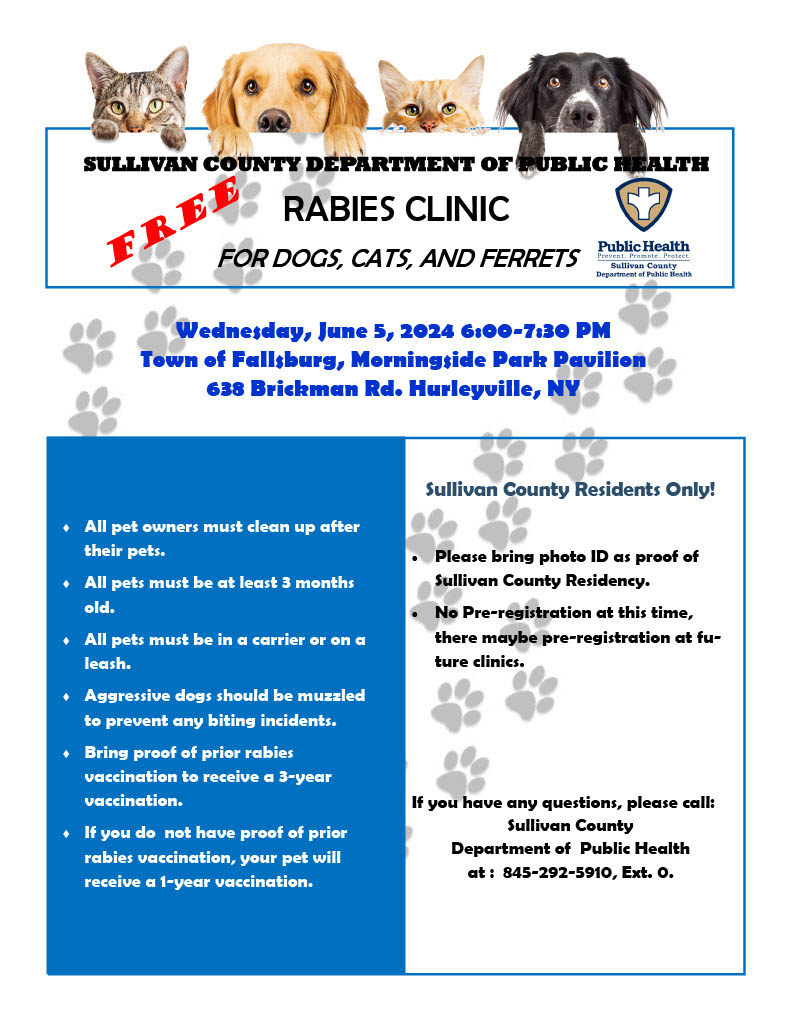
DOG OWNERS

            Times are hard right now and money is tight. The last thing we need as dog owners is a $200 - $300 bill from our vet to get our dog licensed renewed. Free Rabies clinics are few and far between yet there are options. One such option is Petco in Middletown. They offer every Sunday between 2:30 & 4:30 rabies shots for a small fee of $17.00, $15.00 for the rabies shot and $2.00 for needle disposal. Please give them a call, 845-692-6691, and check them out.


======================================================================================

 2009 ELECTION INFORMATION


                        2009 elections will be upon us soon. The Town of Lumberland is seeking anyone interested in becoming an election inspector or election custodian to please contact The Town Clerk’s Office -  (845) 856-8600 Ext. 210 & 228, or by stopping by the office at 1054 Proctor Road, Glen Spey, N.Y.

All new Inspectors & Custodians will have to attend mandatory training and will be paid by the County Board of Elections. The Primary Day Election will be held on Tuesday, September 15, 2009 and is open from 12:00 p.m. (Noon) to 9:00 p.m. The General Election will be held on Tuesday, November 3, 2009 and is open from 6 a.m. to 9 p.m. Both Elections are held at the Town Hall, Glen Spey, N.Y.


==============================================================================

VOTER REGISTRATION FORM


            This form may be used to register to vote in New York State, change your name and/or addresses, if there is a change since you last voted, or enroll in a political party or change your enrollment.

            You can register to vote in person at your County Board of Elections on any business day. Voter registration applications are also available in the Town Clerk’s Office. Anyone wishing to register to vote must have the application delivered to the County Board of Elections not later than 25 days before the election in which you want to vote. You must be 18 years old by the date of the election in which you want to vote. Your eligibility to vote will be based on the date you file this form, and your County Board of Elections will notify you of your eligibility.


==============================================================================

ABSENTEE BALLOT APPLICATIONS


Primary & General Election Absentee Ballot Applications are available at the County Board of Elections in Monticello, N.Y. or in the Town Clerk’s Office, 1054 Proctor Road, Glen Spey, N.Y.

These applications must be mailed or delivered to the County Board of Elections no later than the 7th day before any given election, however, if the application by a qualified voter whose illness or physical disability shall commence on a day following the tenth day before such election may be received by the Board of Elections not later than the day preceding such election.

Any voter who may be unavoidable absent on the day of election may deliver the application in person to the Board of Elections, not later than the day preceding such election. Unless you have applied for an absentee ballot as a permanently disabled person, each application is only good for the Primary, Special or General Election to which it specifically pertains. Unless you are permanently disabled you must renew your absentee application for each Primary, Special or General election if you are still eligible to vote absentee.

If you have any questions about voting in an election please call the Town Clerk’s Office at (845) 856-8600 ext, 210, or call the Sullivan County Board of Elections at (845) 807-0400


==============================================================================


IMPORTANT NEWS FOR HUNTERS & FISHERMAN


The following is a listing of new fees, which will be charged for the 2009/2010 Hunting and Fishing season. The 2009/2010 and fishing licenses sales will start in August 2009

LICENSE FEE PRICES STARTING 2009-2010 LICENSE YEAR

                                                         NY RESIDENT                      NON RESIDENT


            FISHING LICENSE              

            REGULAR                                         $29.00                                                 $70.00

            1 DAY                                                $5.00                                                   $15.00

            7 DAY                                                 $15.00                                                 $35.00

            Military Disabled                                $5.00   `                                                  N/A

            Senior 70+                                          $5.00                                                      N/A

            Marine                                                $10.00                                                 $15.00

            1 Day Marine                                      $.4.00                                                  $5.00

            7 Day Marine                                      $8.00                                                   $10.00

            HUNTING LICENSE

            Small Game                                         $26.00                                                 $85.00

            Big Game                                               N/A                                                   $140.00

Small & Big Game                              $29.00                                                    N/A

Sportsman                                           $47.00                                                    N/A

Sportsman Military Disabled              $5.00                                                      N/A

Sportsman 70+                                    $10.00                                                    N/A

Super Sportsman                                $88.00                                                 $280.00

Conservation Legacy                         $96.00                                                    N/A

Bow                                                     $21.00                                                 $140.00

Bow Military Disabled                        $0.00                                                      N/A

Bow 70+                                              $0.00                                                     N/A

Muzzleloading                                     $21.00                                                 $140.00

Muzzleloading Military Disabled       $0.00                                                      N/A

Muzzleloading 70+                             $0.00                                                      N/A

Turkey                                                $10.00                                                 $50.00

Trapper Super Sportsman                  $88.00                                                    N/A

Trapping                                             $21.00                                                 $310.00

Trapping Military Disabled                $0.00                                                      N/A

Trapping 70+                                      $5.00                                                      N/A

Jr. Hunt                                              $5.00                                                   $5.00

Jr. Bow                                               $9.00                                                   $9.00

Jr. Muzzleloading 14-15 Yrs.              N/A                                                    $140.00

DMP Instant 16                                  $10.00

DMP FCFS 16+ (w/Big Game)           $10.00

DMP FCFS 14+ LT Spt-jr H/B          $0.00

DMP Instant 14+ LT Spt-jr H/B        $0.00

OTHER ITEMS                 


Habitat Stamp                                     $5.00                                                   $5.00

Conservation Patron                          $12.00                                                 $12.00

Trail Patch                                          $5.00                                                   $5.00

Magazine                                            $10.00


OTHER ITEMS (Contd.)


Sports Education Certificate              $1.00

Replacement Licenses                       $5.00

Replacement Carcass Tags                $10.00

Replacement Lifetime Card               $5.00

Replacement Back Tag                      $0.00


LIFETIME LICENSES


ADULTS                                                                     CHILDREN


Sportsman                                           $765.00                                               Sportsman 0-4 Yrs.                 $380.00

Big & Small Game                              $535.00                                               Sportsman 5-11 Yrs.               $535.00

Fishing                                                $460.00                                               Sportsman 12-15 Yrs.             $765.00

Marine Fishing                                   $150.00                                               Big & Small Game 0-15 Yrs.  $535.00

Marine Fishing and Fishing Combo   $450.00                                               Fishing 0-15 Yrs.                    $460.00

Bow                                                     $235.00                                               Bow 0-15 Yrs.                         $235.00

Muzzleloading                                     $235.00                                               Muzzleloading 0-15 Yrs.         $235.00

Trapping                                             $395.00                                               Trapping 0-15 Yrs.                 $395.00

Inscription                                          $0.00                                      

                        SENIORS


Senior Sportsman 70+                        $65.00

Senior Fishing 70+                             $65.00


==============================================================================


From the April 2009 Conservationist


Intruders!

New York's battle to stop the spread of invasive species

By Leslie Surprenant


It was late afternoon last May when the phone in DEC's fisheries office in New Paltz began to ring again. It had already been a busy day full of calls from anglers looking for good spots to fish, but this call was different. The caller, a pond owner from Orange County, said he'd caught two strange fish in his pond and was worried they might be snakehead fish-the recent invader from Asia that has found its way into some of our waters and is known for its ferocity and ability to decimate native fish populations. The owner wanted DEC to check the pond to make sure the local fish would be okay. It was a call that grabs any biologist's attention, and one that's becoming more common. Another problem invader spotted; another battle about to begin. If the pond really did contain snakeheads, there was work to be done.

Gearing up, DEC biologists quickly prepared to go afield. If they could catch the intruders before they could get established, damage to the local ecosystem could be kept to a minimum. A short time later, it was confirmed-the fish were indeed the predatory northern snakehead fish. To determine the extent of the invasion, DEC surveyed the landowner's entire pond and connecting waters, catching three live snakeheads that ranged in size from finger length to two feet. This was not a good sign. The presence of young fish confirmed the fish were not only present, but reproducing. And because of the pond's location, biologists realized there was a high risk the fish would quickly move downstream into the Wallkill River, giving them access to the Hudson River and the potential to move through the canal system and into the Great Lakes within a few years.

After looking at a number of possible solutions, DEC determined the best chance of successfully eliminating this aggressive invasive was to treat the pond with rotenone, a piscicide (fish killer) derived from Amazonian plants. A number of concerned local volunteers helped DEC conduct the treatment, which yielded a surprisingly large number of snakeheads. In fact, the pond and connecting waters held more than 220 snakeheads, most young-of-the-year, but also 13 adults that ranged in size up to 31 inches and more than 11 pounds. The immediate threat was stopped, but everyone wondered how the fish arrived in this Orange County pond.

A popular Asian food, snakehead fish were commonly available in the live fish market, and sold as aquarium fish until they were prohibited from interstate transport in 2002 as "injurious wildlife" under the federal Lacey Act. In New York, State Environmental Conservation Law prohibits possession of live snakehead fish and their viable eggs. Perhaps someone wanted to establish a fishery here, or simply released an aquarium pet that had grown too large, or become too aggressive. Regardless, it's clear that these fish were intentionally released into the pond; just one example of the many harmful invasive species that humans introduce into the environment each year. Unfortunately, very few people realize that these introductions can spell disaster to the local ecosystem.

Introducing new species is not a new concept. In fact, it has been going on for a long time. Native American tribes widely traded and cultivated non-native species such as corn, beans and squash. Farmers, anglers, hunters, gardeners, collectors, aquarium owners and animal lovers alike have all brought in new species they felt would provide some benefit or pleasure. In some instances, scientists introduced non-native species to either occupy an unused habitat or to control another species considered a pest. Intentions were good. No one realized the actions might be harmful.

Not all non-native species were introduced on purpose. Some found their way here by accident, carried in packing or ballast water from a foreign destination. It's possible that one or more new species arrived 400 years ago, aboard the Halfmoon as Henry Hudson plied the river that would be named for him.

Over time, thousands of non-native plants and animals have arrived and taken hold in New York. Most are harmless. Some, like honey bees, are beneficial. Others, like the snakehead, are harmful. Only 10 - 15% of non-native species are harmful invasives-threatening our environment, agriculture or health.

It's important to make the distinction between non-native species and invasives. While all invasives are non-natives, not all non-native species are invasives. Officially, invasives are defined as non-native species that cause significant harm to humans or the environment. Simply put, invasive species are biological pollution.


An adult emerald ash borer
Hidden in transported firewood, the
Emerald ash borer has spread rapidly
eastward from Michigan, the site of
original infestation.


What many people don't realize is that their actions can contribute to the problem. Simple activities such as hiking, camping, boating, fishing, gardening and landscaping can spread invasive species. For example, unsuspecting campers transporting firewood are believed to have spread the emerald ash borer (EAB) from its original infestation sites into the forests of Michigan's famed Upper Peninsula. A small, metallic-green beetle native to Asia, the emerald ash borer probably arrived in the U.S. in wooden packing materials brought into the port cities of Chicago, Toronto and Detroit. Since its arrival, the beetle has killed millions of trees in Michigan and Ohio, and is working its way eastward, rapidly approaching New York.

The Asian longhorned beetle is another insect believed to have arrived here in wooden packing crates. Upon reaching New York City from China, this beetle quickly infested several species of local hardwoods, killing thousands of trees. Like EAB, the Asian longhorned is not a strong flier, but can inadvertently be spread via transportation of infested firewood.   

An adult Asian longhorned beetle on tree bark
The Asian longhorned beetle is also
spread by the transport of infested firewood
.


Another contributor to the introduction and spread of invasives is the well-meaning person who releases the unwanted pet (i.e., frogs, turtles, fish, or something more exotic like a big cat) into the local pond or woods. While this may seem harmless, the released animal can upset the delicate biological balance by preying on local species and competing with them for food and shelter. In some cases, like snakehead fish, they can reproduce, quickly taking over an area to the detriment of local species. Such was the case in a number of Adirondack ponds where unknowing anglers released their unused baitfish into the pond they were fishing. The baitfish quickly reproduced, out-competing and decimating prized native brook trout populations.

The difficulty with invasives is that they typically arrive here without their native predators and diseases that normally keep their numbers under control in their countries of origin. This automatically gives them an advantage over native species that have these controls in place. Left unchecked, the introduced species are able to flourish, generally at the expense of our native species.

The introduction of non-native pathogens is another type of biological pollution facing New York. Since our native species often lack resistance to these new invasive pathogens, the results can be disastrous. For instance, West Nile virus, which likely arrived through global travel, has sickened and killed humans and birds. Likewise, viral hemorrhagic septicemia, which probably arrived in ballast water and spread by the live bait trade, has killed tens of thousands of fish in New York and other Great Lakes states.


A zebra mussel seen with human fingers for size comparison
Zebra mussels have spread quickly from
the Great Lakes to the Hudson River and
several inland waters.


Ship ballast water is considered the likely vector for a number of other invasive introductions, including zebra and quagga mussels, which clogged intake pipes and removed microscopic plankton, the base of the aquatic food web. Zebra and quagga mussels spread quickly, likely carried in boats, bait buckets and live wells. Since first introduced into the Great Lakes, these mussels have spread into the Hudson River and several inland waters.

The Chinese mitten crab is another troublesome invasive, thought to have arrived here via ballast water, or possibly through the international live food trade. Mitten crabs are catadromous, reproducing in the ocean, with their young moving into freshwater tributaries where they remain upstream until adulthood. They burrow into stream banks, causing bank instability and collapse, resulting in lost habitat for native species. Mitten crabs compete with native crabs and other aquatic animals for food, and are able to move tremendous distances along stream bottoms. The first mitten crab reported in New York was an adult caught in a crab pot in the lower Hudson River in June 2007. By autumn 2008, they had spread into many tributaries and were being trapped in crab pots in Catskill, nearly 100 miles upstream. In California, mitten crabs severely harmed commercial and recreational fishing by tearing nets, pinching netted fish and taking anglers' bait. Additionally, these crabs may carry Asian lung fluke, a human parasite.


The flower and seed head of the giant hogweed plant
Giant hogweed was introduced as an
ornamental garden plant.


             Our desire to create or duplicate showy exotic gardens and landscapes, or to use and grow new herbs and spices is responsible for introducing a number of non-native plant species to the state. Nurseries and garden centers make it easier by selling these new plants. While many of these introductions have had minimal negative impact, a number of invasive plants have escaped gardens and landscapes. Garlic mustard, introduced for culinary uses, can rapidly invade hardwood forest understory. Japanese knotweed, introduced for beauty and ease of cultivation, can spread thickly along stream banks, but offers no erosion control. Giant hogweed was introduced as an ornamental garden plant. An aggressive competitor, its large size and rapid growth enables it to quickly out-compete native plant species. Contact with its sap can result in severe blistering, permanent scarring-even blindness-upon exposure to sunlight (see August 2003 Conservationist).


A large clump of didymo held over a stream
Tiny particles of the algae, Didymo can
attach to felt-soled waders and contaminate
other streams.


Didymo, or rock snot, is a recent invader of New York's waters. It is an unsightly algae, forming dense wavy mats that may harm fisheries habitat in flowing coldwater streams. Because Didymo cells are microscopic, it can spread by a single drop of water, easily hitching a ride on felt-soled waders.

Once an invasive species has arrived, successful eradication depends on early detection. As was the case with the snakeheads in the Orange County pond, early detection and quick action may have prevented its spread. Once a species spreads, eradication or control through conventional techniques is difficult. Occasionally a pest or predator of the invasive species is discovered. Often, these "biological control" species are also non-native species and so researchers must proceed carefully, demonstrating that the control will not harm similar native species. This uses precious time and is costly.

           With new invasive species discovered each year, effectively monitoring and controlling them are difficult tasks. Further complicating and challenging this is climate change. Milder winters, changing precipitation patterns and warmer summers stress our native fauna and flora while favoring many invasive species, diseases and pests. Several New York State agencies are engaged in coordinated state, regional and federal invasive species management and prevention efforts. To aid in early detection, New York has partnered with the New York Natural Heritage Program to develop a reliable, accurate online invasive species database (iMapInvasives.org). Available to the public, this will greatly assist tracking and responding to any invasions. With New York's diverse landscapes and wide variety of ecosystems, tackling the issue of invasives is best approached through a coordinated regional effort. Eight Partnerships for Regional Invasive Species Management (PRISM) are being formed across the state to provide volunteers with training in invasive species monitoring, eradication, control, education and outreach.  Successfully controlling invasives will ultimately require everyone's help. Like the gentleman who called to alert DEC to the presence of snakeheads in his pond, we all need to be responsible in our individual choices and actions. We can start by recognizing how our everyday activities may contribute to the invasion, and then act to prevent or slow the spread. While we will not stop all invasions of harmful non-native species, we can work together to help ensure future generations of New Yorkers will enjoy our forest landscapes, healthy ecosystems and productive agricultural lands.

Leslie Surprenant is the invasive species management coordinator in DEC's Office of Invasive Species Management in Albany.

Don't aid the invasion

• Learn and teach others about invasive species.
• Always use native or non-invasive plants for gardens, landscapes and ponds.
• Check, clean/disinfect and dry boats, live wells, waders, life jackets and fishing equipment. Quaternary ammonium compounds found in many household disinfectants are effective in controlling many aquatic invasive species, fish viruses and pathogens.
• Do not move bait or other fish from one water to another, and don't release unused baitfish and worms. Instead, dispose of them in closed containers.
• Purchase baitfish from retailers selling certified
disease-free fish.

• Report plants, animals and insects you recognize as new or out-of-the-ordinary. You may contact your regional DEC office, the Office of Invasive Species or a Partnership for Regional Invasive Species Management (PRISM).
• Don't move firewood. New restrictions to protect our forests from insects and disease prohibit moving firewood more than 50 miles from where it is grown and prohibits importation of untreated firewood from out of state)
• Don't release any animal, plant or seed into the wild including reptiles, aquarium plants & fish, and mammals.
• Don't stock ponds with exotic fish, frogs, crayfish, snails or other organisms. Any fish stocking requires a stocking permit; contact the DEC regional office in which your water is located.

 • Join a PRISM. These partnerships are involved with invasive species management, education, early detection and rapid response and are a great way for citizens to get involved.


RESOLUTIONS MAY 2009


#63 - Noise Permits - Camp Lokanda
#64 - Comprehensive Plan Copying Project Appointment
#65 - Advertise Surplus Town Hall Old Chairs
#66 - Bid Award - Circle Park Basketball Court (Held for June)
#67 - Inter Municipal Agreement - Roads Study (Held for June)
#68 - Support Legislation Amendment - Environmental
Conservation Law  (Local Roads)
#69 - Noise Permits - Brookwood Camp
#70 - Advertise Surplus Dog Control Officer Vehicle
#71 - Advertise Bid - New Highway Loader

 =====================================================================================


ENVIRONMENTAL MANAGEMENT COUNCIL


==============================================================================


Thank you to all who contributed their time and energy in the Litter Pluck on Saturday 25 of April. A truckload of garbage was collected from the sides of our roads and taken to the transfer station. Next year we have our sites set on even more community involvement and to help keep our town litter free.

Once again, we had a successful Earth Day. The day was filled with activities that included: face painting, planting seeds, rock painting, a visit from Smokey the Bear and an incredible animal show.   The UDC supplied us with terrific information about our area, and the Mckenzie School children made rain sticks to sell so they could sponsor a piece of land in the rain forest. The Lumberland Fire Department provided food and beverages for the day. Our residents and visitors enjoyed themselves and appreciated the information that was available.

Thank you to everyone who participated in making Earth Day a success.

As you know, the EMC has made ongoing Water Testing a priority. Our waters are being tested this month, and the results will be available to all.

If you have any questions or concerns regarding water testing, or you would like to get involved with the testing, please let us know. You may contact Ann Danuff @ 856-7989 or Cheri Bodnaruik @ 858-7987.

 ======================================================================================

FIRE DEPARTMENT


==============================================================================


     I’d like to talk a little about the dispatching of emergency services. In an emergency you call 911. You want help and you want it immediately. Here is a brief summary of the way things work. The 911 center is located at Sullivan County Airport in White Lake. When you call 911, your call is routed there to a group of dispatchers seated inside a ring of computer monitors. Each dispatcher wears a headset and has three screens in front of him/her. Using the phone number you called from, the information for that number is displayed on the screen. It includes, among other pertinent information, the street address, a picture of your house, your name and cross streets. The dispatcher quickly determines the nature of your emergency and the appropriate response agency is summoned. If you have a medical emergency, an operator, called an EMD (Emergency Medical Dispatcher,) will interview you and provide you with life saving instructions if necessary. Depending on the extent of the trauma or brevity of a medical call (like a stroke or chest pain) the dispatcher must follow a certain set of guidelines for an agency response. Calls are deemed, A, B, C, D, and E in order of severity of the call, A being the least severe and E being the most dire. A and B calls are basic calls and require just a Basic Life Support ambulance, like Lumberland’s ambulance and crew. We are trained to the Emergency Medical Technician (EMT) level. Calls that may require medicines, intubations or advanced levels of care are the C, D and dreaded E calls. Lumberland ambulance is paged out and we will begin care, administer some medicines and transport, but an advanced life support (ALS) ambulance will also be responding from either Regional Ambulance in Port Jervis or Mobile Medic in Monticello. The paramedic (a level above EMT) on the paid provider ALS units will come on board Lumberland’s ambulance and accompany us to the hospital and also assist in caring for you. This is for your benefit and pre-determined by the information you gave the 911 centers. Upon arrival at your emergency, a Lumberland EMT might determine that you do not need the ALS unit and *may* cancel its response, but only if we are absolutely sure you do not meet the state mandated criteria. 

     Lumberland is unique in that it runs an ambulance out of its fire department. There is only one other fire company that runs an ambulance in Sullivan County. Most towns have a separate corps that handles medical emergencies, like American Legion in Eldred and Tusten Ambulance in Narrowsburg.  Because we are a fire department and everyone who is a fireman is also an ambulance member, we thankfully have many hands to help out at an emergency. We have been very successful in managing our own calls. Just for your information, many corps cannot crew their ambulance, especially in the daytime, and are placed on a “black list” of sorts. Those corps automatically would have either a paid provider or a mutual aid corps dispatched for them on their next call, until they can prove that they can crew up again. It’s a great safety net for the people who need help and their own townships ambulance can’t respond, but imagine how long it would take to get help from a few towns away or even farther! Thank goodness we have not needed to use that provision!

      Fire emergencies are handled much the same way. If you report a fire, we respond. We do have an in-house order of response for trucks depending on the nature of the fire. In other words if there is a house fire, we just about empty the station. For a brush fire we may only take the brush truck, engine and tanker.

     We respond via pager clipped to our belts. Just recently we have been able to receive text messages delivered to our cell phones from the 911 center describing your emergency. This has been a wonderful adjunct to dispatching and getting your volunteers informed and responding. Finally, remember we are sounding the siren for all emergency calls. This is for your safety, and we have found that it is a great way to summon help to the station for those of us who often forget their electronic devices (sigh, guilty…) 

Lumberland Fire Department Auxiliary


           We here at the Lumberland Fire Department Auxiliary are planning an exciting year of fun as we help out at the Firehouse. After all, everyone there is doing so much to keep our community safe, we enjoy doing things to help make them comfortable.

            At the last installation Dinner, we were able to present the Fire Department with a gift of furniture for their ready area and pots and pans ect., for their kitchen area. We were able to raise the money to do this with the help of the Auxiliary members while having fun, selling our Holiday of Prizes raffle tickets, cake sales, Gas Card raffle and running the kitchen during the Turkey Shoot. Plus we love helping out at the Chicken BBQ and much, much more!

            We need more members to help us do even bigger events. So please come and join us. We meet at the Lumberland Firehouse on the Third Tuesday of the month at 7 pm.

            The meetings are a great way to meet your neighbors and do something positive for your community. We enjoy coffee or tea and cake after each meeting. All are welcome.


See you there.


Sincerely,

Rosemarie Varagnolo

President, Lumberland Fire Department Auxiliary


======================================================================================

CONSTABULARY


==============================================================================


In this issue we at the Constabulary would like to talk about outdoor safety while enjoying the fantastic natural scenery our town has to offer. With school ending soon children and young adults apparently are the most at risk. Close supervision by responsible adults when feasible tends to lessen the possibility of an unforeseen tragedy. Here are some safety tips that may help your children (including yourself) avoid unnecessary injury while celebrating the start of summer.

* From tricycles to motorcycles HELMETS are a must.   IT’S THE LAW!

* While enjoying the town's waterways personal flotation devices (lifejackets) are a must. The imbibing of alcohol while operating a boat is a dangerous combination and should be avoided.

* When driving a vehicle all front seat passengers should wear a safety belt. All back seat passengers under the age of 16 must wear a safety belt.

* Do not drink and drive while operating any type of motor vehicle.

* Fireworks of any type (including sparklers) are illegal in New York State due to safety concerns. Do not let children use or handle fireworks under any circumstances. Serious injury can result and has happened in the past thus necessitating the need for strong laws against using them.

All of us here at the Constabulary would like this summer season to be the best yet for all. Keep in mind these tips and hopefully they can help you and your children reduce the likelihood of serious injury.

So from all of us, to all of you,       


            HAVE AN ENJOYABLE AND ACCIDENT FREE SUMMER!!!!


Mongaup River, Town of Lumberland, NY
Pond Eddy Bridge, Pond Eddy, NY
Welcome to the Town of Lumberland, NY

This project was assisted by a grant from the Upper Delaware Council, Narrowsburg, NY 12767

Copyright 2008 T-Bone Web, Matamoras, PA 18336, All Rights Reserved.